
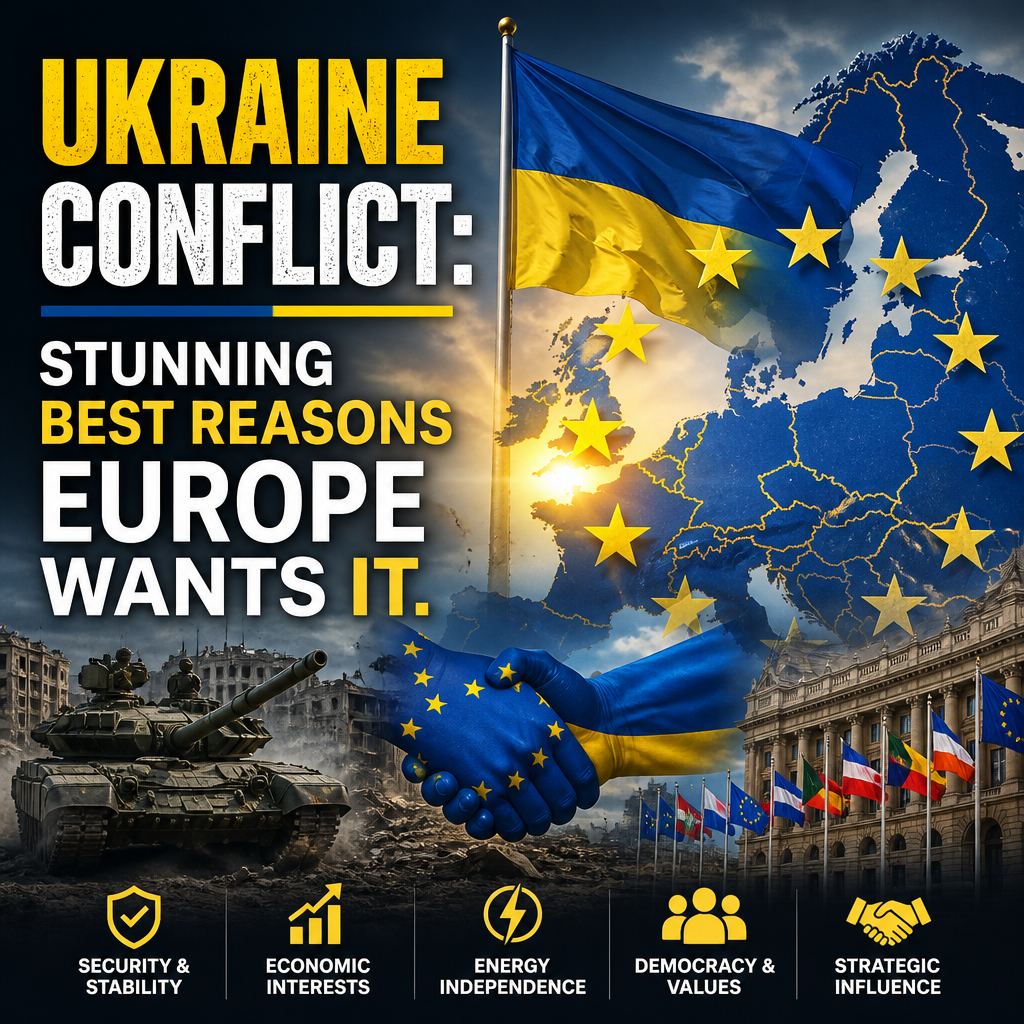
Ukraine Conflict: Stunning Best Reasons Europe Wants It


Ukraine conflict has become one of Europe’s defining political tests, and the reasons many European governments want to stay deeply engaged are more layered than simple solidarity. Across international coverage, a common thread emerges: European leaders see Ukraine not only as a neighboring country under attack, but also as a frontline issue for security, energy, diplomacy, and the future credibility of the continent’s institutions.
Why Europe sees the Ukraine conflict as more than a distant war
At the most basic level, Europe’s interest is strategic. The war has unfolded on the edge of the European Union, and officials in many capitals view its outcome as something that could shape borders, alliances, and deterrence for years. If a larger state can redraw a neighbor’s future by force, the concern goes, then smaller European countries may feel less secure and the entire post-Cold War order becomes more fragile.



That strategic logic appears in different forms across the news coverage. Some reporting emphasizes the hard security calculation: supporting Ukraine is seen as a way to prevent instability from moving westward. Other coverage focuses on the humanitarian and political dimensions, showing that Europe’s support is also tied to images of destruction, displacement, and civilian suffering that have kept public attention on the war. Even when the tone differs, the underlying point is similar: the conflict is not viewed as an isolated regional event.
There is also a practical reason Europe remains involved. The war has exposed how dependent the continent can be on external security arrangements and energy supply chains. In the early stages of the conflict, European governments had to confront gas shortages, inflation pressures, and the political consequences of sanctions. For many policymakers, helping Ukraine became linked to reducing Europe’s own vulnerability over time, even if the short-term costs were painful.




Ukraine conflict and the competing narratives shaping European policy
Not all coverage frames Europe’s motives in the same way. Some commentary, especially from RT, tends to stress the idea that Western Europe’s backing for Ukraine is driven less by principle than by self-interest, escalation, or geopolitical rivalry. That perspective argues that European leaders may be using the conflict to reinforce their own strategic relevance, justify military spending, or align more closely with broader Western policy goals.
By contrast, Al Jazeera’s wider reporting often places the war within a broader global context, highlighting civilian consequences, refugee flows, and the diplomatic fallout for countries far beyond the battlefield. This framing does not ignore strategic concerns, but it tends to underline the human cost and the difficulty of finding a settlement that does not leave Ukraine even more exposed.
Sky News coverage, meanwhile, often reflects the pressures inside European democracies: public support for Ukraine remains significant, but it is not limitless. Elections, inflation, defense budgets, and fatigue all shape what governments can promise. That matters because Europe’s backing is not a single, fixed position. It is a moving balance between moral commitment, domestic politics, and the fear of a wider security crisis.
Seen together, these viewpoints reveal an important truth: Europe’s desire to support Ukraine is not based on one reason alone. It is a mix of:
– deterrence and security planning
– support for international law
– concern over humanitarian suffering
– fear of economic disruption
– political pressure to remain united
The hard choices behind European support
The strongest case for Europe’s involvement is that inaction could be even more expensive later. Leaders who favor support argue that allowing aggression to succeed may invite further instability, force larger defense spending, and weaken Europe’s ability to influence events in its own neighborhood. In that sense, support for Ukraine is being treated as an investment in European security.
But the counterargument is serious, too. The longer the war lasts, the more difficult it becomes for European governments to sustain public patience. Weapons deliveries, financial aid, reconstruction plans, and sanctions all have costs. Some citizens worry about a slow drift into permanent confrontation, especially if diplomacy appears stalled. Others question whether Europe can keep absorbing the economic consequences while also dealing with migration pressure and domestic social needs.
This is where the article’s sources reflect a deeper disagreement about what “support” should mean. For some, it means helping Ukraine resist until it can negotiate from strength. For others, it means avoiding steps that could deepen the conflict or lock Europe into an open-ended commitment. These are not minor differences; they shape how long aid lasts, what kind of weapons are delivered, and how much room remains for talks.
A balanced view: necessity, risk, and uncertainty
The most responsible conclusion is that Europe wants Ukraine because the war forces it to confront its own future. The conflict touches defense, energy, economics, and the credibility of European institutions all at once. That makes support for Ukraine seem less like optional charity and more like a defensive response to a shifting geopolitical reality.
Still, the situation remains uncertain. Europe may agree on the importance of resisting aggression, but it is less united on the endgame. Can Ukraine win enough to negotiate safely? Can Europe maintain solidarity if the war continues for years? Can diplomacy emerge without rewarding force? Those questions do not have easy answers, and the coverage from different news organizations reflects that uncertainty rather than resolving it.
What is clear is that Europe’s reasons are both moral and pragmatic. It wants Ukraine to survive, but it also wants to protect itself from the consequences of a war that has already reshaped the continent. That combination explains why European governments remain engaged, even as the debate over costs, strategy, and peace grows sharper.

























